Dear God, open a door for my message, so that I may proclaim the mystery of Christ. I pray that I may proclaim it clearly, as I should. Colossians 4:3-4

R4C

R4C
Reconciliation and Forgiveness ~ I am Sorry * Please Forgive Me * Thank You * I Love You. ~ Reconciliation and Forgiveness ~ I am Sorry * Please Forgive Me * Thank You * I Love You. ~ Reconciliation and Forgiveness ~ I am Sorry * Please Forgive Me * Thank You * I Love You.

Generosity from the Heart

Generosity from the Heart


Matt 6:3, "do not let your left hand know what your right hand is doing"


If this blog is informative and helpful in your pursuit to follow Jesus, and deepening your Christian faith;

Please support my work. Thank you and God Bless.


Proverbs 11:25, "A generous person will prosper; whoever refreshes others will be refreshed."


How to make contibution (click on this link)


May the Lord bless you for your generosity, and may the Mother of God intercede for your every need.


Your act of generosity will be rewarded, and your blessing will be “pressed down, shaken together, and RUNNING OVER.

Psalm 19:14, May the words of my mouth and the meditation of my heart be pleasing in your sight, O LORD, my Rock and my Redeemer.
Showing posts with label responsibility. Show all posts

Tuesday, 20 November 2018

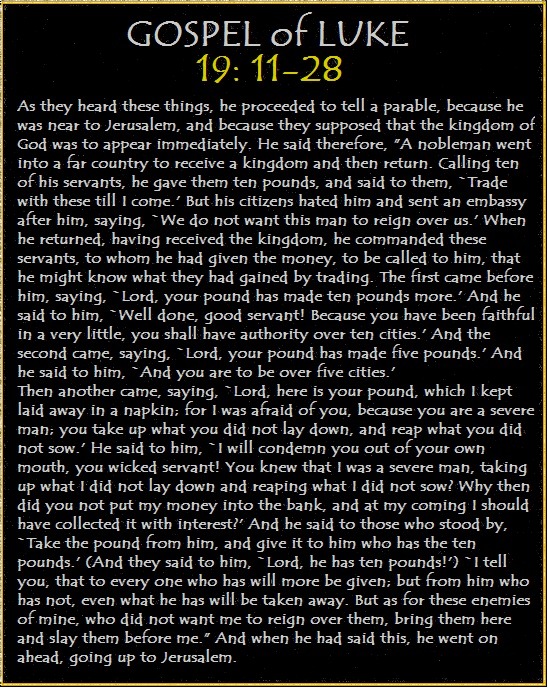
They did not want me to reign over them


How does God establish his kingdom here on the earth?


The Jews in Jesus' time had a heightened sense that the Messiah would appear soon to usher in the kingdom of God's justice, love, and peace on the earth (Isaiah 11:1-9). Jesus, in fact, spoke in messianic terms of the coming reign of God. Perhaps his entry into Jerusalem would bring about such a change and overthrow of Roman domination. 


Parable of the talents

Jesus speaks to their longing for a new kingdom in the parable of a nobleman who went away to receive a kingdom. The parable reveals something important about how God works his plan and purpose with his people. The parable speaks first of the king's trust in his subjects. While he goes away he leaves them with his money to use as they think best. While there were no strings attached, this was obviously a test to see if the Master's workers would be industrious and reliable in their use of the money entrusted to them. The master rewards those who are industrious and faithful and he punishes those who sit by idly and who do nothing with his money. 

The essence of the parable seems to lie in the servants' conception of responsibility. Each servant entrusted with the master's money was faithful up to a certain point. The servant who buried the master's money was irresponsible. One can bury seeds in the ground and expect them to become productive because they obey natural laws. Coins, however, do not obey natural laws. They obey economic laws and become productive in circulation. The master expected his servants to be productive in the use of his money. 


The Lord rewards those who faithfully use their gifts and talents for doing good by giving them more 

What do coins and the law of economics have to do with the kingdom of God? The Lord entrusts the subjects of his kingdom with gifts and graces and he gives his subjects the freedom to use them as they think best. With each gift and talent, God gives sufficient means (grace and wisdom) for using them in a fitting way. As the parable of the talents shows, God abhors indifference and an attitude that says it's not worth trying. God honors those who use their talents and gifts for doing good. Those who are faithful with even a little are entrusted with more! But those who neglect or squander what God has entrusted to them will lose what they have. 


The Lord expects us to be good stewards of the gifts and graces he gives us

There is an important lesson here for us. No one can stand still for long in the Christian life. We either get more or we lose what we have. We either advance towards God or we slip back. Do you seek to serve God with the gifts, talents, and graces he has given to you?

The Lord Jesus offers us a kingdom of justice, love, and peace and he calls us to live as citizens of this kingdom where he rules as Lord and Master. Through his atoning death on the cross and through his resurrection victory, Jesus frees us from a kingdom of darkness where sin and Satan reign. Through the power of the Holy Spirit the Lord gives us freedom to live as his servants and to lay down our lives in loving service of our neighbors (Galatians 5:1,13). Do you trust in God's grace to make good use of the gifts and talents he has given you?

Lord Jesus, be the ruler of my heart and mind and the master of my home and goods. Fill me with a generous and wise spirit that I may use the gifts, talents, time, and resources you give me for your glory and your kingdom.

source: From the desk of Don Schwager, 
hosted by Kairos Europe and the Middle East


Monday, 2 July 2018

Teacher, I will follow you wherever you go


Are you ready to follow the Lord Jesus wherever he may lead you? In love, the Lord Jesus calls each one of us personally by name and he invites us to follow him as our Lord and Teacher. What an awesome privilege and an awesome responsibility! What does it cost to be a disciple and follower of the Lord Jesus? Our whole lives, for sure! The Lord Jesus in turn promises to give us all that we need to follow him and more besides! Before we "sign-up" for something, it is quite natural and appropriate to ask what it will cost us. Jesus made sure that any "would-be" followers knew what they were getting themselves into.

The cost of discipleship 
One prospective follower, a scribe who was an expert in the Torah (the law of God in the first five books of Moses in the Jewish bible), paid Jesus the highest compliment he knew. He called Jesus "teacher". Jesus advised this would-be follower: Before you follow me, think what you are about to do and count the cost. A disciple must be willing to part with anything that might stand in the way of following Jesus as Teacher and Master. Another would-be disciple responded by saying that he must first bury his father, that is go back home and take care of his father until he died. This disciple was not yet ready to count the cost of following Jesus. Jesus appealed to the man's heart to choose for God's kingdom first and to detach himself from anything that might keep him from following the Lord.

The greatest call 
The Lord Jesus invites us into the most wonderful and greatest of relationships - a personal relationship of love and friendship, trust and commitment with himself, the Lord and Ruler of the heavens and the earth. How can we give the Lord our unqualified "yes" to the call he has for our lives? The Lord Jesus fills the hearts of those who accept his invitation of discipleship and friendship with the outpouring of his love into our hearts through the gift of the Holy Spirit who has been given to us (Romans 5:5). The love of God frees us from attachments to other things so we can give ourselves freely to God for his glory and for his kingdom. It was love that compelled the Lord Jesus to lay down his life for us. And he calls us in love to give our all for him.

We cannot outgive God 
What can keep us from giving our all to God? Fear, self-concern, pre-occupation, and attachment to other things. Even spiritual things can get in the way of having God alone as our Treasure if we put them first. Detachment is a necessary step if we want to make the Lord our Treasure and Joy. It frees us to give ourselves without reserve to the Lord and to his service. There is nothing greater we can do with our lives than to place them at the service of the Lord and Master of the universe. We cannot match God in generosity. Jesus promises that those who are willing to part with what is most dear to them for his sake "will receive a hundred times as much and will inherit eternal life" (Matthew 19:29). Is there anything holding you back from giving your all to the Lord?

Take, O Lord, and receive my entire liberty, my memory, my understanding, and my whole will. All that I am and all that I possess you have given me. I surrender it all to you to be disposed of according to your will. Give me only your love and your grace - with these I will be rich enough and will desire nothing more.

source: From the desk of Don Schwager, 
hosted by Kairos Europe and the Middle East

Thursday, 12 April 2018

He who believes in the Son has eternal life


Do you hunger for the true and abundant life which God offers through the gift of his Holy Spirit? The Jews understood that God gave a certain portion of his Spirit to his prophets. When Elijah was about to depart for heaven, his servant Elisha asked for a double portion of the Spirit which Elijah had received from God (2 Kings 2:9). 

The Holy Spirit opens our minds to understand God's word of truth 
Jesus tells his disciples that they can believe the words he speaks because God the Father has anointed him by pouring out his Spirit on him in full measure, without keeping anything back. The function of the Holy Spirit is to reveal God's truth to us. Jesus declared that "when the Spirit of truth comes, he will guide you into all the truth" (John 16:13). When we receive the Holy Spirit he opens our hearts and minds to recognize and understand God's word of truth.

Saint Augustine of Hippo (354-430 AD) said, "I believe in order to understand; and I understand the better to believe." Faith opens our minds and hearts to receive God's word of truth and to obey it willingly. Do you believe God's word and receive it as if your life depended on it?

God gives us the freedom to accept or reject what he says is true. But with that freedom also comes a responsibility to recognize the consequences of the choice we make - either to believe what he has spoken to us through his Son, the Lord Jesus Christ, or to ignore, reject, and chose our own way apart from God. Our choices will either lead us on the path of abundant life and union with God, or the path that leads to spiritual death and separation from God.

Love the Lord, cling to him, and you will have life 
God issued a choice and a challenge to the people of the Old Covenant: "See I have set before you this day life and good, death and evil. ...I call heaven and earth to witness against you this day, that I have set before you life and death, blessing and curse; therefore choose life, that you may live, loving the Lord your God, obeying his voice, and cleaving to him" (Deuteronomy 30:15-20). And God issues the same challenge to the people of the New Covenant today. Do you weigh the consequences of your choices? Do the choices you make lead you towards life or death - blessing or cursing?

If you choose to obey God's voice and to do his will, then you will know and experience that abundant life which comes from God himself. If you choose to follow your own way apart from God and his will, then you choose for death – a spiritual death which poisons and kills the heart and soul until there is nothing left but an empty person devoid of love, truth, goodness, purity, peace, and joy. Do your choices lead you towards God or away from God?

Lord Jesus Christ, let your Holy Spirit fill me and transform my heart and mind that I may choose life - the abundant life you offer to those who trust in you. Give me courage to always choose what is good, true, and just and to reject whatever is false, foolish, and contrary to your holy will.

source: From the desk of Don Schwager, 
hosted by Kairos Europe and the Middle East

Wednesday, 22 November 2017

They did not want me to reign over them


How does God establish his kingdom here on the earth? The Jews in Jesus' time had a heightened sense that the Messiah would appear soon to usher in the kingdom of God's justice, love, and peace on the earth (Isaiah 11:1-9). Jesus, in fact, spoke in messianic terms of the coming reign of God. Perhaps his entry into Jerusalem would bring about such a change and overthrow of Roman domination.

Parable of the talents 
Jesus speaks to their longing for a new kingdom in the parable of a nobleman who went away to receive a kingdom. The parable reveals something important about how God works his plan and purpose with the human race. The parable speaks first of the king's trust in his subjects. While he goes away he leaves them with his money to use as they think best. While there were no strings attached, this was obviously a test to see if the Master's workers would be industrious and reliable in their use of the money entrusted to them. The master rewards those who are industrious and faithful and he punishes those who sit by idly and who do nothing with his money.

The essence of the parable seems to lie in the servants' conception of responsibility. Each servant entrusted with the master's money was faithful up to a certain point. The servant who buried the master's money was irresponsible. One can bury seeds in the ground and expect them to become productive because they obey natural laws. Coins, however, do not obey natural laws. They obey economic laws and become productive in circulation. The master expected his servants to be productive in the use of his money.

The Lord rewards those who faithfully use their gifts and talents for doing good by giving them more
What do coins and the law of economics have to do with the kingdom of God? The Lord entrusts the subjects of his kingdom with gifts and graces and he gives his subjects the freedom to use them as they think best. With each gift and talent, God gives sufficient means (grace and wisdom) for using them in a fitting way. As the parable of the talents shows, God abhors indifference and an attitude that says it's not worth trying. God honors those who use their talents and gifts for doing good. Those who are faithful with even a little are entrusted with more! But those who neglect or squander what God has entrusted to them will lose what they have.

There is an important lesson here for us. No one can stand still for long in the Christian life. We either get more or we lose what we have. We either advance towards God or we slip back. Do you seek to serve God with the gifts, talents, and graces he has given to you?

The Lord Jesus offers us a kingdom of justice, love, and peace and he calls us to live as citizens of this kingdom where he rules as Lord and Master. Through his atoning death on the cross and through his resurrection victory, Jesus frees us from a kingdom of darkness where sin and Satan reign. Through the power of the Holy Spirit the Lord gives us freedom to live as his servants and to lay down our lives in loving service of our neighbors (Galatians 5:1,13).

The Lord expects us to be good stewards of the gifts and graces he gives us 
The Lord entrusts us with his gifts and graces and he gives us freedom to use them as we think best. With each gift and talent, the Lord gives sufficient grace and strength for using them in a fitting way. As the parable of the talents shows, God abhors indifference and an attitude that says it's not worth trying. God honors those who use their talents and gifts for doing good. Those who are faithful with even a little are entrusted with more! But those who neglect or squander what God has entrusted to them will lose what they have. There is an important lesson here for us. No one can stand still for long in the Christian life. We either get more or we lose what we have. We either advance towards God or we slip back. Do you trust in God's grace to make good use of the gifts and talents he has given you?

Lord Jesus, be the ruler of my heart and mind and the master of my home and goods. Fill me with a generous and wise spirit that I may use the gifts, talents, time, and resources you give me for your glory and your kingdom.

source: From the desk of Don Schwager, 
hosted by Kairos Europe and the Middle East

Thursday, 9 November 2017

The necessity of prudent foresight


Do you make good use of your money and possessions? Jesus seemed to praise a steward (a manager entrusted with his master's goods) who misused his employer's money. What did the steward do that made Jesus praise him? The steward was responsible for managing his wealthy landowner's property. The steward very likely overcharged his master's tenants for their use of the land and kept more than his fair share of the profit. When the landowner discovered the steward's dishonest practice he immediately removed him from his job, leaving him penniless and ashamed to beg or do manual work.

The necessity of prudent foresight to avert disaster 
Before news of his dismissal became public knowledge, the shrewd steward struck a deal with his master's debtors. In discounting their debts he probably was giving up his generous commission. Such a deal won him great favor with the debtors. Since the steward acted as the landowner's agent, such a deal made his master look very generous and forgiving towards those who owned him money. Surely everyone would praise such a generous landowner as the town hero! Since the master could not undo the steward's cancellation of the debts without losing face and making his debtors resent him, he praised the steward for outwitting him and making him appear as a generous and merciful landowner.

Jesus obviously thought that the example of a very clever steward would be a perfect illustration for a spiritual lesson about God and how God treats those who belong to his kingdom. What's the point of Jesus' parable? The dishonest steward is commended not for mishandling his master's wealth, but for his shrewd provision in averting personal disaster and in securing his future livelihood. The original meaning of "shrewdness" is "foresight". A shrewd person grasps a critical situation with resolution, foresight, and the determination to avoid serious loss or disaster.

Faith and prudent foresight can save us from moral and spiritual disaster
Jesus is concerned here with something more critical than a financial or economic crisis. His concern is that we avert spiritual crisis and personal moral disaster through the exercise of faith and foresight. If Christians would only expend as much foresight and energy to spiritual matters, which have eternal consequences, as they do to earthly matters which have temporal consequences, then they would be truly better off, both in this life and in the age to come.

God loves good stewardship and generosity 
Ambrose, a 4th century bishop said: The bosoms of the poor, the houses of widows, the mouths of children are the barns which last forever. True wealth consists not in what we keep but in what we give away. Possessions are a great responsibility. The Lord expects us to use them honestly and responsibly and to put them at his service and the service of others. We belong to God and all that we have is his as well. He expects us to make a good return on what he gives us.

God loves generosity and he gives liberally to those who share his gifts with others. The Pharisees, however, had little room for God or others in their hearts. The Gospel says they were lovers of money (Luke 16:14). Love of money and wealth crowd out love of God and love of neighbor. Jesus makes clear that our hearts must either be possessed by God's love or our hearts will be possessed by the love of something else. What do you most treasure in your heart?

Lord Jesus, all that I have is a gift from you. May I love you freely and generously with all that I possess. Help me to be a wise and faithful steward of the resources you put at my disposal, including the use of my time, money, and possessions.

source: From the desk of Don Schwager, 
hosted by Kairos Europe and the Middle East